
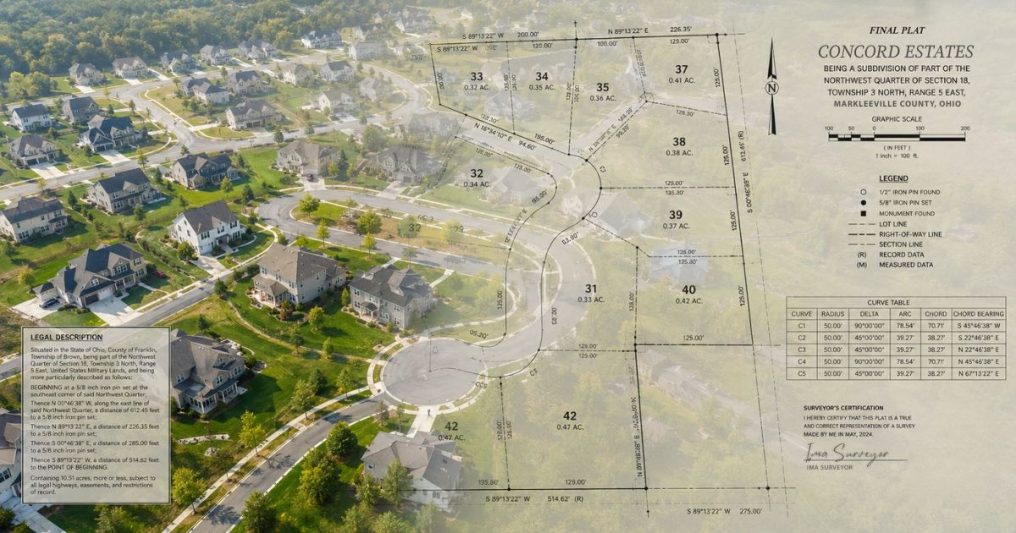
We’ve heard it before: location, location, location! But, without understanding the “where,” there can be real confusion about what a person is purchasing and how to locate the property. Real property is identified with what is known as a “legal description”. A legal description is what a property owner conveys – not a property address. Errors in a property’s legal description, however, can lead to title issues. Let’s discuss a few issues and strategies to prevent and address these problems.
Legal descriptions are created by a professional surveyor. Whether it is a platted property or a metes-and-bounds property, the legal description describes how to locate the property on the ground. From iron rods, pins, and monuments the description uses such items to discern the boundaries of the property. There, however, can be mistakes in the written legal descriptions, from typographical issues with the direction or distance to issues with measurements between past and current surveyors. In other situations, legal descriptions may use a different point of beginning for multiple tracts, which may cause confusion between property owners’ legal descriptions without the use of a professional surveyor to identify the actual boundaries.
Alliant National’s claims department sees several cases involving legal descriptions. Below are a few common issues:
- the legal description is not included with the recorded deed, mortgage, or deed of trust;
- the legal description is incomplete;
- the legal description has typographical errors;
- the legal description references an incorrect subdivision or references an erroneous plat book or page; or
- ownership of property is being challenged due to a gap in the property or an overlap of the property’s legal description with that of a neighboring property owner.
A missing or erroneous legal description can result in title claims such as intervening conveyances and liens, lack of actual conveyance of the property, and challenges from another party who believes they may have better title. Legal description issues can be time-consuming and may be challenging to cure.
If your state has statutes for correction affidavit usage, such statutes may only be applicable when certain requirements are met. If the situation is not covered or the requirements are not met under the statute, then a correction affidavit most likely is not available. In such cases, a corrective instrument may be required from a party, or litigation may be necessary to resolve the legal description issue.
Attention to detail can significantly reduce the occurrence of legal description issues. Here are a few tips:
- Purchase Contract and Addendums. When parties change the purchase contract’s legal description, remember to incorporate the changes into the real estate closing platform to ensure that when it is time to print documents, the documents properly reflect the accurate legal description.
- For example, the parties may have originally contracted for Lots 1, 2 and 3, Main Plat. Subsequently, through an addendum, the contract now only dealing with Lots 1 and 3, Main Plat. Make sure the documents reflect only Lots 1 and 3, Main Plat.
- Who else should know of changes? Let your team and any third-party vendor know of any changes made to the legal description and request that the title products be revised, and new title products issued to reflect the change. Then, distribute the revised title products to the proper parties.
- Also let the lender know of any legal description changes as soon as you learn of them. Lenders may use this information to obtain an appraisal of the property and determine its value as part of the lender’s underwriting review.
- In some cases, the lender may prepare the deed of trust or mortgage and may include a legal description into the instrument. Review the instrument prior to the closing for accuracy of the legal description. If the legal description is inaccurately reflected, contact the lender immediately to discuss.
- Review and ask questions. When a survey is purchased or a prior survey showing the property’s legal description is being reviewed, review that survey for any differences shown in the seller’s vesting deed (and those in the chain) against what has been prepared for the conveyance of title. If there are differences, ask questions and review them with the surveyor and the parties to clear up any discrepancies. Also, document your file to indicate how the parties addressed and resolved the situation.
- The parties. Review all documents prior to the closing to ensure they accurately reflect the legal description the seller intends to convey, and the buyer intends to purchase. Also, review and compare any legal description changes that the parties agreed to in the contract or purchase contract addendum.
- Recording. When sending the instrument to the county recorder’s office, remember to include the correct legal description with the instrument.
- Policies. When a final title policy is issued, review to make sure the correct legal description is included in Schedule A before sending it to the recipient.
As a reminder, take a moment to thoroughly review the property’s legal description to ensure the legal description included is what is intended by the parties to be conveyed. This will significantly reduce potential errors that could lead to claims. If you have questions, please feel free to reach out to Alliant National.
Resources:
Colorado Revised Statutes Title 38, Sec. 38-51-111 (Surveyor’s affidavit of correction) – https://law.justia.com/codes/colorado/title-38/survey-plats-and-monument-records/article-51/section-38-51-111/
Florida Statutes, Title XL, Sec. 689.041 – http://www.leg.state.fl.us/statutes/index.cfm?App_mode=Display_Statute&URL=0600-0699/0689/Sections/0689.041.html
Texas Property Code, Title 2 – Conveyances, Chapter 5 – Conveyances, Sec. 5.027-5.031 https://statutes.capitol.texas.gov/Docs/PR/htm/PR.5.htm
This blog contains general information only, not intended to be relied upon as, nor a substitute for, specific professional advice. We accept no responsibility for loss occasioned to any person acting on or refraining from action as a result of any material on this blog.